
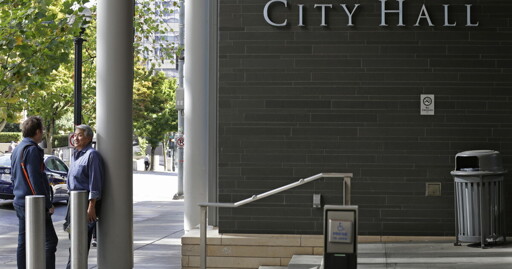
The building that last stood there, the public safety building, was demolished in 2005. Since then, the giant hole in the ground has become a part of the downtown landscape. Some of the most powerful offices in city government, including those of the mayor and a few members of Seattle City Council, look directly into the abandoned lot.
The City of Seattle concluded earlier this year that the developer who owns the long stalled high rise project across from City Hall is in default of a 2017 agreement it signed with Seattle when it took over land.
As a result, Seattle’s Finance and Administrative Services told the developer, Bosa, it could seek damages of up to $5,000 a day depending on the length of the delay, though the city has so far declined to levy these fines, according to a spokesperson.
Bosa disagrees that it is in default. In its response to the city – and in a statement to KUOW – the company blamed “the extreme deterioration in market conditions which began with COVID, the extreme construction cost escalation that followed and the profound impacts on the neighborhood which continue today have made performance of the original development plan impossible.”
Bosa took over the project after the previous developer, Triad, was entangled in an alleged quid pro quo campaign finance scandal involving a City Council race.
Jon Grant, a council candidate, was a tenant advocate with an open lawsuit against Triad on behalf of its tenants. A Triad executive said that if Grant could drop the suit, the executive could make a negative ad campaign against Grant disappear. News of the exchange led to the city ending its contract with Triad.
Progress on the long stalled project has likely become difficult to pencil in the current downtown economy, say city officials and local real estate experts. Office vacancy is at nearly 35% in the Central Business District. Residential high rises, like apartments and condos, come with their own challenges — interest rates are high, construction costs are up, and rents are relatively stable.
“If I were a developer, I would be hesitant unless you could get those costs down because rents are flat now,” said Councilmember Eddie Lin, who chairs the land use committee.
Even if the city fined Bosa the maximum amount, it is unclear whether this would move the needle on a project valued at around $300 million.
“We ought to find out,” said former Deputy Mayor Tim Burgess, who sponsored the legislation that passed the land to Bosa.
“ I think the city needs to apply more pressure,” Burgess said.
It’s not clear when or if the city will fine the developer, but Councilmember Eddie Lin said all options should be on the table .
“ We need to take a hard look at what we do want to see and how do we get there,” Lin said.
I miss the Gorillaz-esque artwork the wall fence previously had 15 years ago
The City of Seattle concluded earlier this year that the developer who owns the long stalled high rise project across from City Hall is in default of a 2017 agreement it signed with Seattle when it took over land.
As a result, Seattle’s Finance and Administrative Services told the developer, Bosa, it could seek damages of up to $5,000 a day depending on the length of the delay, though the city has so far declined to levy these fines, according to a spokesperson.
$5000 per day since 2017 = $16.4M
Could Seattle Parks & Rec build a public park on that lot within 12 months, including a serviceable public restrooms, for $16.4M? I think so.