

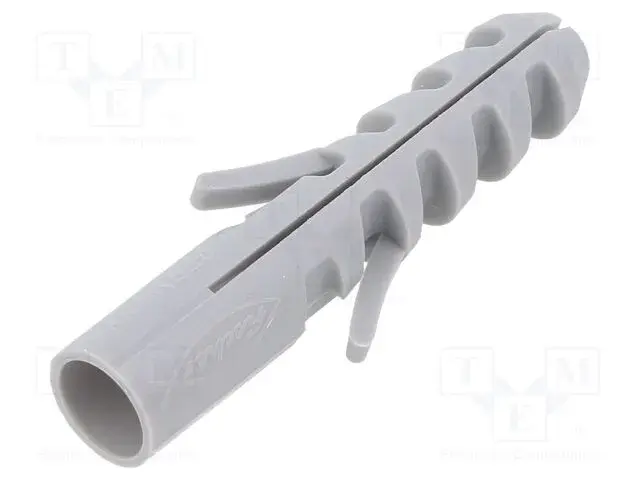
I used a 10mm masonry bit to drill for a 10mm plastic anchor like that pictured. The anchor spins freely in the hole, which I think is expected. I thought I read somewhere that the screw size should be 2mm less than the anchor. Thus 8mm for a 10mm ø anchor. But an 8mm screw is fat enough to rub sides of the anchor as it is inserted because I suppose the anchor is only 1mm thick at the opening. The guy at the shop confirmed that 8mm is too big. He said a 6mm screw matches and sold me those. After installing and loading, the anchor started to pull out.
Do I need a 7mm ø screw? Odd sizes get decreasingly common above 5mm. Yet 10mm sleeves are very common… so it’s not adding up.
I would like to have a reliable PDF chart of bore,anchor, and screw sizes – in metric. It seems there are plenty of such charts for Imperial/English units, like these:
- http://nfaspace.com/services/Forms_files/Anchor Classification Guide.pdf
- https://anchors.dewalt.com/anchors/_documents/uploads/DWANF_ICDWANCHSG_r01.pdf?1659150839
I’m not sure what a “#10” screw or anchor is (sometimes also written as “№10”). Does that refer to the metric size despite being in an imperial system?
(update)
The brick is rendered over with ~10mm plaster. The anchor is flush with the wall so about 10mm of the anchor is wasted. I think the anchor needs to be pushed in to be flush with the brick. But that’s a struggle. I think the proper approach is to screw in the screw just a couple rotations and then to hammer on the screw. But the anchor is either too big for the hole or something. The screw drives in but the anchor does not go with it. I think I will try softening the anchor with a heat gun and then try to push it in deeper. Or maybe I need a fatter screw just to drive the anchor in more.
The problem is worsened by the fact that as I screw, the anchor is coming out by about 5mm. So it’s even shallower than when I start screwing.
(update 2)
Now I see why I cannot get the anchor to be flush with the brick: I only drilled the hole deep enough for the anchor to be flush with the plaster layer.
So one theory is that I need to drill 10mm deeper so the anchor can be flush with the brick not the (useless) plaster. OTOH, the collar of the ancher seems a bit useless anyway for about 10mm.
That looks like it’s for a hollow wall. The middle looks like it’s meant to bend to a huge diameter. If that were inside a brick hole, wouldn’t it just make around 1mm of contact at the point where it bends?
You are right; my mistake! I meant to suggest a wedge type that theoretically functions similarly to the one you posted, using friction between the anchor and the pilot hole, but is made of metal. An important variable I didn’t notice if you mentioned is how much weight you intend to hang. This is what I was imagining:
Make sure to get one that includes a masonry drill bit to remove the hole diameter guess work!
I think some of us are struggling when we see you wanting to use a plastic anchor in masonry. It just doesn’t make sense unless the load will be very low.
Even if the anticipated load weight is low: if you hang, say, a shelf on a brick wall, people who place things on the shelf in the future are likely to assume you used a stronger anchor than plastic.
Edit: I see in other comments you are plenty experienced on the topic of anchors. It seems the brick integrity is your big unknown variable. Maybe I would go with this type if I wanted to avoid chemical: