Yeah, PETA’s propaganda is so focused on showing the horror side and gross out shit that they forget to show why we should be grossed out or horrified in the first place. If someone showed me a pumpkin getting dissected, I am not going to care how “violent” or “gory” it is unless you give me reason to empathize with it. We have alienated people from their food so much, I think people forget that animals are more than food. And secondly, I believe there goals (veganism) are unsustainable, privileged, and unhealthy.
I am not a vegan or vegetarian, despite believing harming living things is ethically wrong. This is because I do believe humans need meat to survive. There are certain nutrients from meat that we simply need, and those nutrients are far too difficult to get without meat. There are just sometimes things that are unethical that we have to do anyways. Sometimes there simply is no ethical choice. That is not to say you shouldn’t strive to make those things as ethical as possible though! We can make meat consumption more ethical, and we should.
I just do not think getting rid of meat from our diet is possible, at least not without some serious innovation in science and our economy. You would need to be able to supply the world’s population with suppliments for every nutrient, vitamin, etc that non-meat food sources struggle to supply in any meaningful way.
All key nutrients can be covered without meat. Proteins, iron, calcium and healthy fats are abundant in plants: beans, lentils, nuts, soy and whole grains supply ample proteinhealth.harvard.edu (even vegans meet protein needs by eating diverse plant foods). Iron can be obtained from legumes and greens (with vitamin C-rich foods to boost absorption), and calcium from leafy greens or fortified plant milks. Omega-3 fats (ALA) are in flaxseed and walnuts, and algal or fortified foods can provide EPA/DHA if needed. Vitamin B₁₂ is the one nutrient not found in plant foods naturally, but health experts point out that vegans simply use fortified foods or a low-cost B₁₂ supplement to meet the requirement. With these adjustments (which many omnivores also make, e.g. vitamin D or fish-oil supplements), a plant-based diet easily meets nutritional needs at any age.
One, as you said it require properly planned meals, which you seem to understate the actual difficulty of that. I can tell you right now, I would have a bitch of a time factoring that level of meal planning into my life. Secondly, while supplements are something you can do, it is not accessible to everyone. Thirdly, allergies complicate things as well, furthering the need for suppliments.
Vitamin b12 deficiency is quite prevalent in both those in a low socioeconomic status, but also vegans and vegetarian. So clearly this is an issue facing vegans despite supplements. Likely due to supplements not being as accessible as you are letting on. Supplements would especially be more inaccessible if everyone became vegan or vegetarian. Hence why I said veganism and vegetarianism require serious scientific and logistical innovation to make possible.
I am also not too keen on centralizing more power to pharma companies. Do we seriously want to take autonomy away from poor regions as they become even more dependent on major pharma companies in the first world so they can get their daily b12 and other vitamins cause of the ethics of meat consumption?
I also genuinely do believe if any ethical issues with harming animals can be extended to plants and fungi. They are able to sense, communicate, and think. Just in very different ways than animals. Fungi particularly are fascinating regarding this. I do not think just because they exhibit that differently means they’re life should be ignored.
You also need to realize we domesticated a bunch of animals, and we would need to decide what to do with thwm. You just gonna release all those animals in the wild? Animals that have become entirely reliant on humans to survive. Or do we kill every one of them? Either way we are sentencing them to death.
And so I say again, just because something is unethical, doesn’t mean you can’t or shouldn’t do it. And just because you can do it, doesn’t mean you shouldn’t do it in the most ethical way you can. If you are able to live as a vegetarian, or even vegan, go ahead. I encourage it. But I do not think it is reasonable or realistic to expect it to become a world standard. Lets take it one battle at a time and work to make the harm we do as ethical as we can realistically do now.
I actually stopped taking B12 supplements, because there was already enough in my food that the supplement was an overload, and so I was getting acne breakouts.
Cattle are also given B12 supplements, because pasture land gets depleted of cobalt after enough grazing. Meat eaters usually get their B12 second hand from a cow pill. I get most of mine from nutritional yeast (Great savory stand in for dry cheeses like parmesan).
Calcium is actually the biggest concern for me, because most meat eaters get their calcium from calcium-fortified non-vegan foods. So that’s the one and only supplement pill I take that most meat eaters wouldn’t.
I think you overestimate the difficulty of it, especially for vegetarianism where you can get all you need from eggs and dairy. Anecdotally I have been vegetarian for 2 years and have never taken supplements and am very healthy, just ran a half marathon in 1:40 which wouldn’t be possible if I was anemic from b12 deficiency. An even larger example is the hundreds of millions of Indians who are vegetarians and have been for millennia, long before supplements existed.
You also underestimate the difficulty in a meat based diet. Every diet requires planning and intentionality to make it healthy. Meat based diets require you to pay far more attention to the amount of fiber you’re getting. Because of this many people who eat meat are not getting enough fiber, 95% of Americans, which leads to intestinal issues and cancers, which is why vegetarians tend to have better health outcomes as noted above since their main source of protein, legumes, are also high in fiber.
As for the efficiency and accessibility it takes far less resources to make b12 with bacteria then with cows/chickens. It wouldn’t take any logistical or scientific innovation to do it either, we know how to make it with bacteria, and it is far more shelf stable and transportable than meat. In general meat production is extremely wasteful and destructive putting aside the ethical arguments. Cows are one of the top sources of greenhouse gases and the demand for them is causing vast tracts of the Amazon to be burned to create new pasture land. If you ask any environmentalist worth there salt what’s the best thing you can do for the planet they’ll say eat less/no meat and drive less/not at all.
How is big pharma less trustworthy than big agriculture? The meat industry is extremely consolidated. Also b12 isn’t patented and the methods to produce it are widely available, there’s no reason it could only be produced in the first world.
For the ethical argument it is valid and depends on your own ethics / philosophy of whether plants / fungi suffer and feel pain. Either way though eating meat is still worse because cows , chickens etc. eat plants to produce meat. Due to trophic loss they consume far more calories and nutrients from plants then they produce in meat, thus killing more plants then is necessary to feed a human. If you want to minimize plant suffering then you should be vegan.
For the existing cows, I’m not advocating for, nor entertaining the absurd idea of outlawing meat eating tomorrow and having to deal with current stock. The cows that are already here are for the most part already doomed to a life of suffering, the best we can do is stop breeding them so we don’t bring more suffering into the world. The best way to stop that from happening is lowering meat consumption which will cause meat producers to stop breeding to deal with the lower demand.
You make good points, and I overall agree with you. Although I don’t believe we need to stop farming animals . I think we can continue farming them for stuff like eggs, milk, wool, etc and do it in ethical ways. What are your thoughts of meat from end of life animals?
I agree that continuing to farm animals ethically solely for the excess products they produce is an achievable, sustainable and ethical goal we should strive for.
If the meat would be wasted anyway then it’s fine to eat. Better us eat it then the maggots. The goal shouldn’t be to just stop people from eating meat, it should be to reduce the amount of animals being bred to serve our taste. If a farmer can only sell the meat after the animal has lived a long life, eating a lot of food that they have to provide, they’ll be less likely to breed them as it wouldn’t be profitable.
It presumably would’ve happened in ancient India as vegetarianism started catching on and cows became sacred.
Even if it didn’t, we’ve never reduced our fossil fuel consumption on a global scale either, that doesn’t mean it’s impossible or that it isn’t something we should / have to do.
a 2025 position paper from the Academy of Nutrition and Dietetics
updated from all previous versions to no longer discuss infants, or women who are pregnant or nursing. but the paper does go on to detail all the risks of a vegan diet.
There is in fact a whole array of vitamins and nutrients that are not produced by plants or animals but rather by the microbes living in or around those plants and animals.
You can get vitamin a from carotene which is common in a lot of foods, notably carrots. Even if it wasn’t , same with b12, this is the 21st century, we can synthesize any vitamin , either chemically or with bacteria, without harming animals.
but, to be clear, plants don’t have vitamin a, so your claim that the only nutrient they don’t have is B12 is wrong. and you seem to know it was incorrect, meaning you lied.
I didn’t lie, all the articles I read and my understanding when I posted the first comment was that b12 was the only vitamin you can’t get from a plant based diet. Most of the articles don’t mention vitamin a because the precursor is common and it is not a concern for the great majority of people on plant based diets. Your comment made me research further to discover that carotene is technically just a precursor.
Your resorting to pedentry to avoid trying to refute the fact that most dietary experts agree that a plant based diet can be just as healthy, if not more so then a diet with meat.
No but a vast majority of people can, so vitamin a deficiency is not a concern for the millions of people living healthily on plant based diets. And again for those that aren’t able to synthesize it they can take synthesized retinol supplements without needing to eat meat.


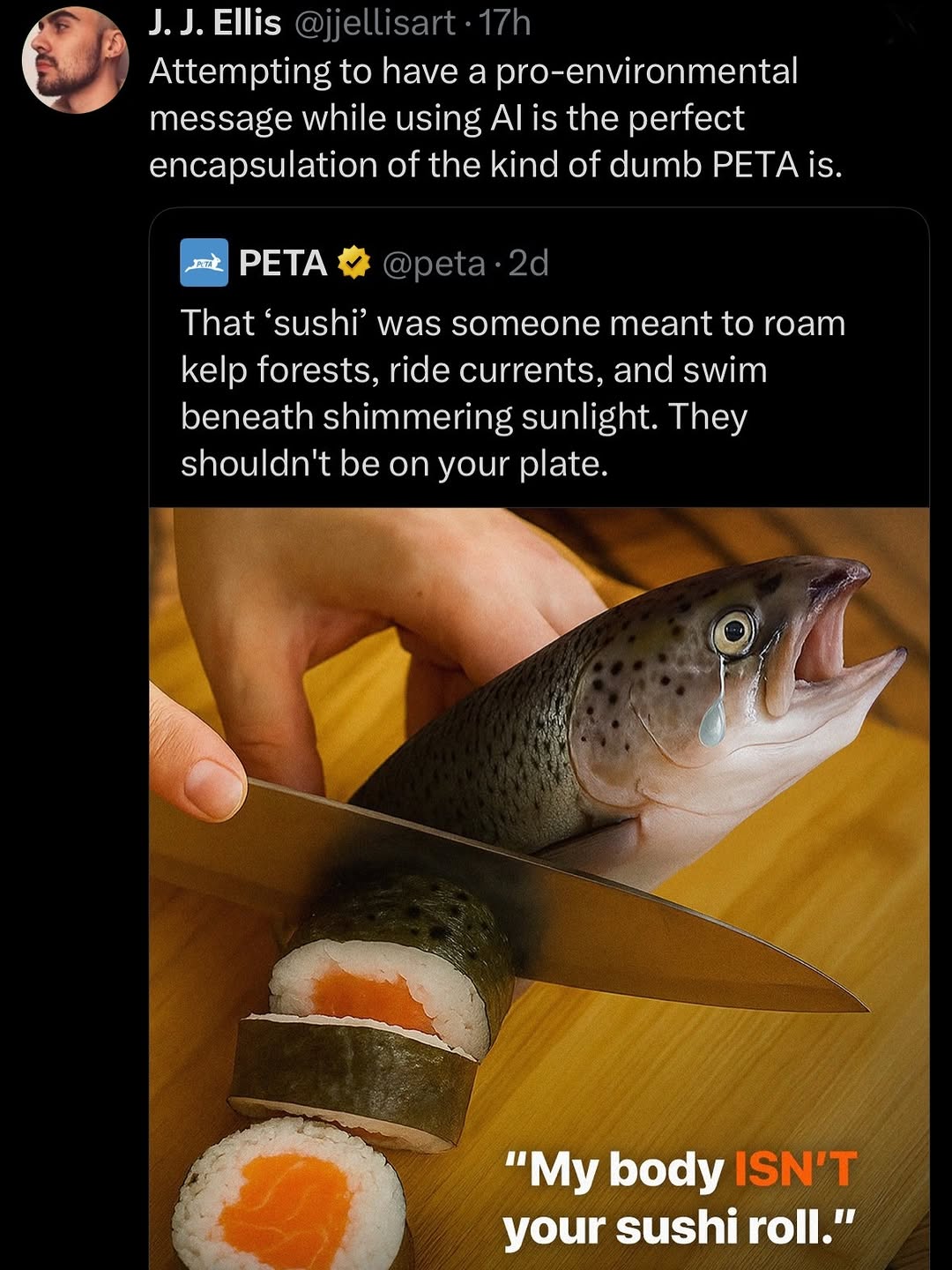
Yeah, PETA’s propaganda is so focused on showing the horror side and gross out shit that they forget to show why we should be grossed out or horrified in the first place. If someone showed me a pumpkin getting dissected, I am not going to care how “violent” or “gory” it is unless you give me reason to empathize with it. We have alienated people from their food so much, I think people forget that animals are more than food. And secondly, I believe there goals (veganism) are unsustainable, privileged, and unhealthy.
I am not a vegan or vegetarian, despite believing harming living things is ethically wrong. This is because I do believe humans need meat to survive. There are certain nutrients from meat that we simply need, and those nutrients are far too difficult to get without meat. There are just sometimes things that are unethical that we have to do anyways. Sometimes there simply is no ethical choice. That is not to say you shouldn’t strive to make those things as ethical as possible though! We can make meat consumption more ethical, and we should.
I just do not think getting rid of meat from our diet is possible, at least not without some serious innovation in science and our economy. You would need to be able to supply the world’s population with suppliments for every nutrient, vitamin, etc that non-meat food sources struggle to supply in any meaningful way.
Major health experts agree that well-planned vegetarian and vegan diets are healthy. For example, a 2025 position paper from the Academy of Nutrition and Dietetics states that “appropriately planned vegetarian and vegan dietary patterns can be nutritionally adequate and can offer long-term health benefits”. Harvard Health (citing the American Dietetic Association) likewise notes that such diets are “healthful, nutritionally adequate” and can help prevent chronic diseases. In fact, plant-based eating is even included as a recommended healthy pattern in recent U.S. dietary guidelines.
Research shows real health gains on plant-based diets. Mayo Clinic reports that vegetarians (when they eat a variety of foods) often have lower risk of heart disease, diabetes and certain cancer. Large cohort studies confirm this: one pooled analysis of over 76,000 people found vegetarians had about 25% lower heart-disease mortality than meat-eaters. These benefits make sense because vegetarians tend to eat less saturated fat and more fiber, vitamins and antioxidants, leading to lower LDL cholesterol, blood pressure and BMI – all factors linked to longevity.
All key nutrients can be covered without meat. Proteins, iron, calcium and healthy fats are abundant in plants: beans, lentils, nuts, soy and whole grains supply ample proteinhealth.harvard.edu (even vegans meet protein needs by eating diverse plant foods). Iron can be obtained from legumes and greens (with vitamin C-rich foods to boost absorption), and calcium from leafy greens or fortified plant milks. Omega-3 fats (ALA) are in flaxseed and walnuts, and algal or fortified foods can provide EPA/DHA if needed. Vitamin B₁₂ is the one nutrient not found in plant foods naturally, but health experts point out that vegans simply use fortified foods or a low-cost B₁₂ supplement to meet the requirement. With these adjustments (which many omnivores also make, e.g. vitamin D or fish-oil supplements), a plant-based diet easily meets nutritional needs at any age.
Finally, plant-based diets aren’t just a privileged fad – they’re common worldwide. For instance, roughly 39% of Indian adults say they are vegetarian, and many cultures eat mostly plant foods Vegetarian and vegan eating is growing (millions of Americans now follow these diets) and is explicitly endorsed by public health authorities as sustainable and healthy.
One, as you said it require properly planned meals, which you seem to understate the actual difficulty of that. I can tell you right now, I would have a bitch of a time factoring that level of meal planning into my life. Secondly, while supplements are something you can do, it is not accessible to everyone. Thirdly, allergies complicate things as well, furthering the need for suppliments.
Vitamin b12 deficiency is quite prevalent in both those in a low socioeconomic status, but also vegans and vegetarian. So clearly this is an issue facing vegans despite supplements. Likely due to supplements not being as accessible as you are letting on. Supplements would especially be more inaccessible if everyone became vegan or vegetarian. Hence why I said veganism and vegetarianism require serious scientific and logistical innovation to make possible.
I am also not too keen on centralizing more power to pharma companies. Do we seriously want to take autonomy away from poor regions as they become even more dependent on major pharma companies in the first world so they can get their daily b12 and other vitamins cause of the ethics of meat consumption?
I also genuinely do believe if any ethical issues with harming animals can be extended to plants and fungi. They are able to sense, communicate, and think. Just in very different ways than animals. Fungi particularly are fascinating regarding this. I do not think just because they exhibit that differently means they’re life should be ignored.
You also need to realize we domesticated a bunch of animals, and we would need to decide what to do with thwm. You just gonna release all those animals in the wild? Animals that have become entirely reliant on humans to survive. Or do we kill every one of them? Either way we are sentencing them to death.
And so I say again, just because something is unethical, doesn’t mean you can’t or shouldn’t do it. And just because you can do it, doesn’t mean you shouldn’t do it in the most ethical way you can. If you are able to live as a vegetarian, or even vegan, go ahead. I encourage it. But I do not think it is reasonable or realistic to expect it to become a world standard. Lets take it one battle at a time and work to make the harm we do as ethical as we can realistically do now.
I actually stopped taking B12 supplements, because there was already enough in my food that the supplement was an overload, and so I was getting acne breakouts.
Cattle are also given B12 supplements, because pasture land gets depleted of cobalt after enough grazing. Meat eaters usually get their B12 second hand from a cow pill. I get most of mine from nutritional yeast (Great savory stand in for dry cheeses like parmesan).
Calcium is actually the biggest concern for me, because most meat eaters get their calcium from calcium-fortified non-vegan foods. So that’s the one and only supplement pill I take that most meat eaters wouldn’t.
I think you overestimate the difficulty of it, especially for vegetarianism where you can get all you need from eggs and dairy. Anecdotally I have been vegetarian for 2 years and have never taken supplements and am very healthy, just ran a half marathon in 1:40 which wouldn’t be possible if I was anemic from b12 deficiency. An even larger example is the hundreds of millions of Indians who are vegetarians and have been for millennia, long before supplements existed.
You also underestimate the difficulty in a meat based diet. Every diet requires planning and intentionality to make it healthy. Meat based diets require you to pay far more attention to the amount of fiber you’re getting. Because of this many people who eat meat are not getting enough fiber, 95% of Americans, which leads to intestinal issues and cancers, which is why vegetarians tend to have better health outcomes as noted above since their main source of protein, legumes, are also high in fiber.
As for the efficiency and accessibility it takes far less resources to make b12 with bacteria then with cows/chickens. It wouldn’t take any logistical or scientific innovation to do it either, we know how to make it with bacteria, and it is far more shelf stable and transportable than meat. In general meat production is extremely wasteful and destructive putting aside the ethical arguments. Cows are one of the top sources of greenhouse gases and the demand for them is causing vast tracts of the Amazon to be burned to create new pasture land. If you ask any environmentalist worth there salt what’s the best thing you can do for the planet they’ll say eat less/no meat and drive less/not at all.
How is big pharma less trustworthy than big agriculture? The meat industry is extremely consolidated. Also b12 isn’t patented and the methods to produce it are widely available, there’s no reason it could only be produced in the first world.
For the ethical argument it is valid and depends on your own ethics / philosophy of whether plants / fungi suffer and feel pain. Either way though eating meat is still worse because cows , chickens etc. eat plants to produce meat. Due to trophic loss they consume far more calories and nutrients from plants then they produce in meat, thus killing more plants then is necessary to feed a human. If you want to minimize plant suffering then you should be vegan.
For the existing cows, I’m not advocating for, nor entertaining the absurd idea of outlawing meat eating tomorrow and having to deal with current stock. The cows that are already here are for the most part already doomed to a life of suffering, the best we can do is stop breeding them so we don’t bring more suffering into the world. The best way to stop that from happening is lowering meat consumption which will cause meat producers to stop breeding to deal with the lower demand.
You make good points, and I overall agree with you. Although I don’t believe we need to stop farming animals . I think we can continue farming them for stuff like eggs, milk, wool, etc and do it in ethical ways. What are your thoughts of meat from end of life animals?
I agree that continuing to farm animals ethically solely for the excess products they produce is an achievable, sustainable and ethical goal we should strive for.
If the meat would be wasted anyway then it’s fine to eat. Better us eat it then the maggots. The goal shouldn’t be to just stop people from eating meat, it should be to reduce the amount of animals being bred to serve our taste. If a farmer can only sell the meat after the animal has lived a long life, eating a lot of food that they have to provide, they’ll be less likely to breed them as it wouldn’t be profitable.
this has never happened
It presumably would’ve happened in ancient India as vegetarianism started catching on and cows became sacred.
Even if it didn’t, we’ve never reduced our fossil fuel consumption on a global scale either, that doesn’t mean it’s impossible or that it isn’t something we should / have to do.
updated from all previous versions to no longer discuss infants, or women who are pregnant or nursing. but the paper does go on to detail all the risks of a vegan diet.
that’s not true. vitamin A, for example.
There is in fact a whole array of vitamins and nutrients that are not produced by plants or animals but rather by the microbes living in or around those plants and animals.
You can get vitamin a from carotene which is common in a lot of foods, notably carrots. Even if it wasn’t , same with b12, this is the 21st century, we can synthesize any vitamin , either chemically or with bacteria, without harming animals.
but, to be clear, plants don’t have vitamin a, so your claim that the only nutrient they don’t have is B12 is wrong. and you seem to know it was incorrect, meaning you lied.
I didn’t lie, all the articles I read and my understanding when I posted the first comment was that b12 was the only vitamin you can’t get from a plant based diet. Most of the articles don’t mention vitamin a because the precursor is common and it is not a concern for the great majority of people on plant based diets. Your comment made me research further to discover that carotene is technically just a precursor.
Your resorting to pedentry to avoid trying to refute the fact that most dietary experts agree that a plant based diet can be just as healthy, if not more so then a diet with meat.
I’m correcting misinformation
b12 and vitamin a aren’t the only nutrients, either
you don’t get it: you synthesize it. and not everyone is good at that
No but a vast majority of people can, so vitamin a deficiency is not a concern for the millions of people living healthily on plant based diets. And again for those that aren’t able to synthesize it they can take synthesized retinol supplements without needing to eat meat.
And yet, here I am.