You must log in or register to comment.
Xer joytoy
Anyone notice spellcheck went dogshit since AI? It flags any common sayings instantly, but takes forever on actually misspelled words. Then I click for a simple correction and it can’t make heads or tails on what the word was supposed to be, even if google search figures it out just fine.
I’m only gen z and I remember spellcheck working way better than this.
Yep, it’s not just you.
Proud google hater for over 20 years now. 😁 I just don’t understand why they’re still relevant at all.
Cause you got a free*, Microsoft Office compatible document viewer/editor, with free* document sharing and collaboration before anyone else made a decent one.
And it was cross compatible with any computer that had a web browser.
It was game changing for small organizations, especially non profits.
The thing is, I was part of a non profit when they released their collaborative mode. It never made a meaningful change to the way we did things.
In a Skype call: person 1 “Hey this sentence is wrong, can you replace it with this? pastes in call chat” person 2 “okay sure”
You could make the argument that it’s clumsy, but I’ll make the argument that nobody is ever fully aware of the changes made to a collaborative doc.
I just don’t understand why they’re still relevant at all.
Largely because thay are a defacto monopoly in too many areas.
Unless some viable competition emerges (or some anti-trust legislation breaks them up), they’re hard to avoid.
Just tried this and couldn’t reproduce. I thought it might be to do with the context - e.g. if the person had been referred to with female pronouns already, but couldn’t get anything from that, either. I then did a few other experiments to check that it was working.
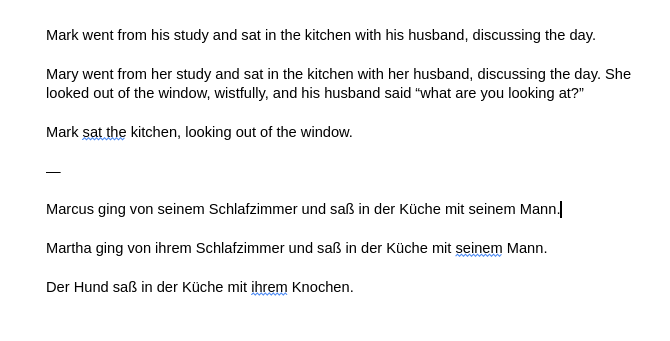
In German, there is a correction for the sentence about Martha, but not for the sentence about Marcus, which is all correct. In English, there is no correction for Mary even though I refer to her inconsistently within a couple of sentences - so maybe this has been special-cased since the screenshot.

So this must be the Antifa I’ve been warned about… by the fascists.
Dontbe evil!
They officially killed that motto some years ago
Eight years, to be precise.
Woah, it’s been that long? Fuck, the 20s have been rough
Can’t expect anything else from google given their love of genocide and hatred of privacy.
Yes you can!(js expect spyware and genocide)
It does. And it’s buggy. Not the colab, but some critical bugs in basic things. Opened an issue and it’s got no attention in months. Even though I love OSS, Nextcloud can be a PITA.
That’s fucked up
Word correctness is driven by societal use. Just like you can add a word not recognized to a spelling dictionary, there could be a way to modify the grammar rules to not correct certain things that you will be using frequently. At least it doesn’t autocorrect.
As a side note, don’t some gay couples call one of themselves the wife? Which interestingly doesn’t seem to be allowed in legal documents in many countries where gay marriages are legal, the term has to be gender based. California seems to have the best solution for the future, “spouse1” and “spouse2” on their documents. Which technically still has one of them listed first… o.O
Reminds me of how automated translation services translate job names into strictly gendered languages. Wihout any context, engineer translates to the male variant and nurse to the female.
Same with translating gender neutral pronouns into languages that don’t have them. “Their husband” will translate into “her husband” (assuming you give sufficient context that “their” is singular in this instance).
It is an issue but there are no obvious solutions.
sort the spouses alphabetically
Alpha move.
Aaron move
BRB changing my name to Aardvark.
I think you are misapplying the principle of “words are how you use them” here; “his husband” is used not-infrequently and is grammatically valid to any English speaker. There is nothing to correct in the original text.
What this is using, however, is statistical frequency of use, which is a different thing altogether. And you know what relies on statistical frequency of language like this? LLMs.
English is full of words and phrases that have secondary meanings, and even obscure or contextual meanings that are real and correct! We cannot cede less popular language choices to AI spellcheck or we lose our own voices and experiences. Acknowledging that gay people exist is a tiny microcosm of this, but it’s important in many other ways too.
There isn’t anything to correct, and that’s why it’s just highlighting it, for the human to look at it because it is a statistical use consideration. If it was used not-infrequently then it wouldn’t have been triggered. Isn’t that how basic non-AI grammar and dictionaries work, and how actual dictionaries consider adding and removing words each year? Archaic and evolving use is still valid if it’s understandable in its context. I get what you’re saying, we should use such things in our text to convey our own thoughts, and thereby make it more statistically valid in the future, but this isn’t the machine trying to imply gay couples don’t exist. Again, there’s no autocorrect here to prevent the human from just looking at it and saying, no, that’s correct.
The real question from a technical pov here is what kind of usage statistic does it take before a conventional grammar checker swings away from flagging something as unusual? I’d think it would have to be rather low to avoid lots of markings. And what sources are being used to evaluate this, and how often?
Dibs on “spouse one.”
Marriage is between spouse 1 and spouse A.